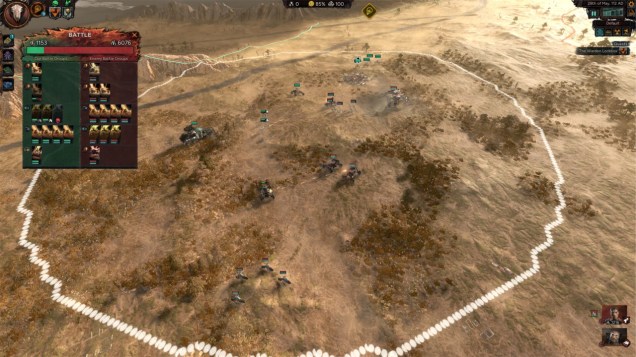
There's no denying that Afterworld is a traditional grand strategy game in many ways–big foggy maps, territorial clashes, macro and micro decision-making–but its end-of-the-world scenario presents an opportunity for Paradox Studios to elevate the genre further still.
Even in the brief glimpse we had during a hands-on play session at Gamescom, a number of differences are already showing. For a start, Afterworld has a very clear focus on lore-building, which is something the more historical games often take for granted. If you're playing as a Roman General or a post-industrial capitalist, the player tends to know what happened before that point, as a rough approximation of historical events can be summed up in an info screen before moving on.
Afterworld is very clearly the outlier: Taking place some 100 years after a mysterious fictional apocalyptic event known only as The Fall, there's a lot to unpack. When you start the game, you're given a vague choice of how you'd like to conduct yourself during the early hours of the campaign.
For the demo, we were the de facto leader of a band of newly emerged vault citizens (where have we heard that before?) and our reactor was about to explode. A ranger was quickly sent into the fog beyond, and our people moved a safe distance away from what was about to be a very smoky hole in the ground.
There are other beginnings to choose from, but the game offers seemingly endless chances to change who you are as you live through its various terrors and triumphs. The beginning is not as important as what you choose to do next. Instead of traditional nations, you'll have bands, tribes of people with established belief systems and leaders–some friends, some foes, some undecided and purely mercenary.
You'll come head-to-head with them fairly quickly, and if they don't get the jump on you, you might be able to integrate them into your society by spreading your values, finding shared beliefs, offering home comforts and political representation, or forcing them to kneel to your might.
As well as managing re. The depth to which this is done dawns on you the more you play. Those decisions you made during the starting slides can quickly be overridden as new ideas emerge. Instead of a traditional technology tree, you'll play with concepts in the Idea Tree, which builds knowledge through specific clusters that are unlocked through exploration.
Your tribe begins to build its story almost immediately, and if you lean into a particular side of the Idea Tree, you might become a pacifistic band of animal herders, a brutal gang of feral cannibals, or a cult looking to follow the path of enlightenment at any cost.
You can embrace or reject old world ideas, as well as making tough choices to survive that could compromise your ability to lead. A cult of personality only works when everyone buys into it, and if people start starving, dying off, or being ignored, you'll have a revolt on your hands.
Your people will also probably, by necessity, be more nomadic than in most grand strategy games. There is a mid-to-late game goal of conquest if you want it, but the first objective of the game is simply to survive. You'll not always emerge somewhere hospitable–procedurally generated disasters will dictate what you find.
Your next area could be irradiated, picked dry by scavengers, or filled with warring tribes. You'll need to gather food and re. Some of the most powerful beings in the game are the Ancients: warlords and religious icons who wield immense power and can be appeased and worshipped or angered and made hostile.
You can also curry their favor and organize a coup if you're confident you have the support. Unlike other grand strategy games where you can choose powerful established nation states to put your weight behind, with Afterworld you will always start as the underdog.
You're not the protagonist of any story, just someone who also has to survive and do what's best for your people. The developers have been very clear that the world moves on with or without you. Afterworld When you join the world in this state, you discover the mechanics of the game at the same pace you discover the in-game world.
A tentative exploration could lead to re. It could also land you in trouble. The consequences of The Fall are far reaching, leaving fragments of story scattered around the map for you to find. Ruined cities can be repatriated and old weapons remade, the technology of the ancient world in-game is still the stuff of science fiction in real life.
Victory conditions are also more survival-adjacent than anything we've seen in most grand strategy games. Afterworld is perhaps more comparable to Frostpunk than anything Paradox has done before. You could, technically, spend all your time and re. You could build your troops and religious fervor and take on one of the Ancients, ruling in their stead, you could build advanced tech and escape to the stars–whatever your idea of survival is, Afterworld says you can make it a reality.
Afterworld is coming to PC but does not yet have a release date.